Cash balance plans can be challenging to understand. We have spent a lot of time discussing how they work. But once you make the contribution the question becomes: where do I deduct cash balance plan contributions on my tax return?
First of all, I hope that you are using a CPA or other tax professional to prepare and file your tax return. But you may be using TurboTax. Even though most CPAs don’t have a lot of familiarity with cash balance plans, they are a great resource. This post should help out both of you.
The good news is that there are a lot of great tax tools available. A great resource is IRS Publication 560. It covers basically all tax issues relating to retirement plans.
I will try to make this post as comprehensive as possible. I will take a look at how to deduct cash balance plan contributions for sole proprietors, S corporations, C corporations and partnerships.
| Tax Type | Where to Record |
|---|---|
| Sole Proprietor | Adjustment to Income & Schedule C |
| Partnership | Line 13: Code R of Schedule K-1 |
| S-Corporation | Line 17 of Form 1120-S |
| C-Corporation | Line 23 of Form 1120 |
Deducting Cash Balance Plan Contributions for a Sole Proprietorship (Schedule C)
Sole proprietors include individuals who do not do business through an entity structure. But it also includes single-member LLCs. The tax code does not distinguish taxation for LLCs itself but it merely looks to the members. If the LLC has one member, it will fall under the sole proprietorship filing requirements.
A sole proprietor will not file a separate tax return for the business. It attaches a Schedule C to report income and expenses of the business activity.
This is a simple form of ownership, but may not be the most tax efficient. Reporting the cash balance plan contributions is a little bit more complex than it is for S corporations and C corporations.
There are two places where a cash balance plan contribution may need to be reported. One is on the Schedule C itself and another place is as an adjustment to income on the 1040 personal return. Let’s take a look at how to record them for both places on the return.
For any cash balance plan contributions made for your employees, you enter them on line 19 of Schedule C. Take a look below.

For any contributions made for you as a self-employed individual, enter the contributions you made on your behalf on Form 1040 Schedule 1. Do not make them on Schedule C. For contributions made for employees, you enter these amounts on Schedule C.
When determining the proper amount to contribute into your cash balance plan or profit sharing plan, your TPA will need your company business profit. This is located on Schedule C, line 31.
Sometimes people mistakenly believe that contributions for sole proprietors are a circular calculation. They must provide their business’s net income to their plan administrator. Once they fund the plan, it reduces their net income, and the calculation must be adjusted accordingly.
As you can see, this is incorrect as you do not report the defined benefit plan contribution on the Schedule C. It is an adjustment to income. As such, you do not get an employment tax deduction for the defined benefit plan contribution with a solo plan.
Deducting Cash Balance Plan Contributions on S-Corporation (1120-S) Tax Return
S corporations are probably the number one entity structure that we see with our clients. It is a very standard form of business ownership. Recording your cash balance plan contributions on an S corporate return is a little more straightforward.
Use EMPARION PLANS on



*Emparion is not affiliated with, endorsed by, or sponsored by these institutions.*
Similar to so proprietorships, there is a line on the tax return that is called pensions profit sharing and retirement accounts. All contributions to plans no matter if they are for the business owner or for employees are reported on this line.
Form 1120-S will summarize all the business expenses on page 1. I you take a look in the deductions section on line #17 you will see a description “Pension, profit-sharing, etc., plans”. Take a look at the image below.

Since S-Corporations are not subject to employment taxes, there is no distinction on the return for owner contributions or employee contributions.
How to Deduct Cash Balance Plan Contributions on C-Corporation (1120) Tax Return
Just like an S-Corp, C-Corps are not subject to employment tax. But there is one significant difference.
C-Corporations pay their own tax, while an S-Corp does not. Accordingly, there is no K-1 for a C-Corp.
Reflecting the contribution on the Form 1120 tax return is really easy. You just include the entire amount on line 23. See the image below:

How to Deduct Cash Balance Plan Contributions on Partnership (1065) Tax Return
A partnership tax return is a little more complex compared to other types of returns. This results from the pass-through taxation, but also the flexibility of how partnership income and expenses can be allocated to the partners.
Is a Cash Balance or Defined Benefit Plan Right For You?

Similar to an S-Corp return, Form 1065 will generate a K-1. This K-1 will have all the information relating to the income allocated to the partners as well as the cash balance plan or defined benefit plan contribution.
K-1 – Line 1
The first step is to look at box 1 of the K-1. The ordinary income will be shown here. See the image below:
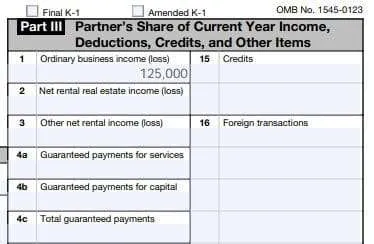
But that is just the first step. In this example, you can see that there is $125,000 in box 1. This is the profit allocated to a specific partner, but it does NOT include the cash balance plan or defined benefit plan contribution.
K-1 – Line 14
But it is important to note that just because there is an amount included in box 1, it does not mean that the partner is allowed to have a retirement contribution. The partner must be actively involved in the business in order to receive a retirement plan contribution.
So we would need to look at box 14 of the K-1 to make sure that there is an amount identified as self-employment earnings. Let’s take a look at the bottom portion of the K-1:

In this example, the amount in box 1 equals the amount in box 14. This is typical for active partners who would be eligible for a retirement contribution. The amount in box 14 is the amount that the actuary would use to calculate the targeted contribution for the given year.
K-1 – Line 13: Code R
Let’s assume that the actuary has determined that the target contribution is $50,000 (for this partner) and the partnership has made this contribution. Where do you include this on the tax return?
Cash balance plan and defined benefit plan contributions fall under the qualified plan category and are included on line 13: Code R. Here is what the IRS says below in the instructions:

Once you have included the amount on the K-1 line 13: Code R it should look like the following:

Just a note. We have focused above on how the contribution is reflected on the K-1. But the total cash balance plan or defined benefit plan contribution should be reflected on page 4 to form 1065. It is reflected in the K-1 section on line 13. The entire amount is entered here and then allocated out to the partners on line 13: Code R of the K-1.
As with sole proprietors, people often mistakenly believe that defined benefit plan contributions for partnerships are circular calculations. They must provide net income from their K1s to their plan administrator. Once they fund the plan, the net income is reduced, and the calculation must be rerun.
But you can see this is incorrect. For owner-only plans, you do not report the defined benefit plan contribution on the face of Form 1065 as a business deduction. It is reported on Line 13: Code R of Schedule K-1. Like a sole proprietor, there is no employment tax deduction for the defined benefit plan contribution.
Final Thoughts
Properly reflecting cash balance plan or defined benefit plan contributions on your tax return can be easy (S-Corp) or more complex (partnership) depending on which type of return you file. Just make sure that you carefully review your tax return with your CPA to ensure that amounts are properly reflected. No one needs an IRS letter or audit.
How to deduct cash balance plan contributions on your tax return:
- Determine entity type. The location on the tax return depends of course on what type of legal entity you have.
- Don’t confuse amounts paid in the current year with deductible amounts. If you are a cash basis taxpayer, the general rule is that you deduct the contributions in the year made. But you can deduct them if you choose up to the date you file your taxes.
- Enter on the return. After careful review, enter the amounts in the proper place on the tax return. You will also include any 401k profit sharing amounts in the same place. But don’t enter any 401k deferrals. These are offset on the W2.
- Verify the return is accurate. Once everything is entered go back and double check that the amounts and location on the return are accurate. You don’t need any IRS red flags.
- Consider hiring a tax professional. These plans can be complex. So if you are not experienced with the tax issues then hiring a professional might be your best bet.